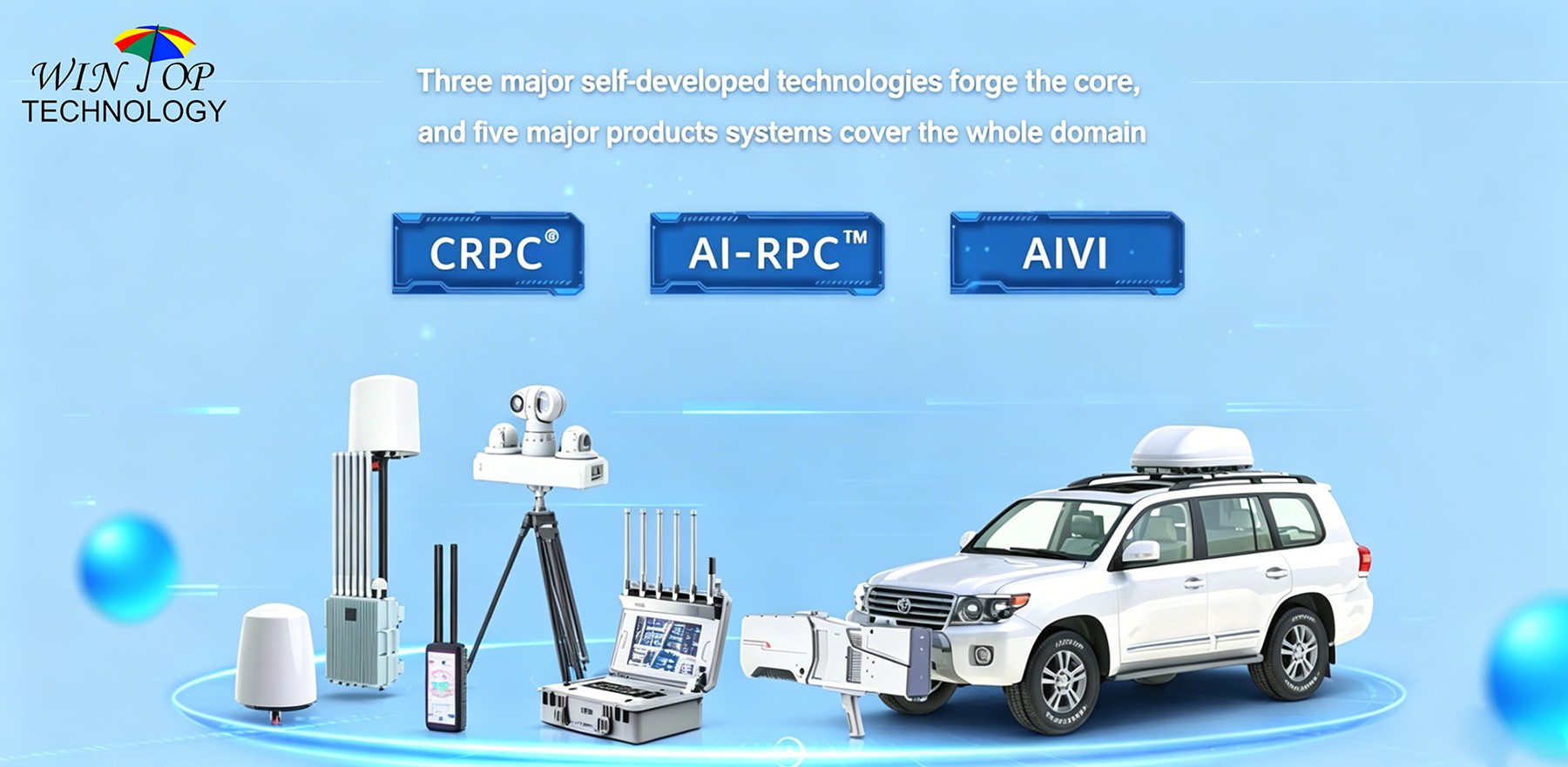
The Sentinel Passive Detection Series includes the Sentinel B (TDOA) model, with a detection range covering the 30 MHz to 6 GHz frequency band and key bands at 400 MHz, 800 MHz, 900 MHz, 1.2 GHz, 1.4 GHz, 2.4 GHz, 5.2 GHz, and 5.8 GHz. The detection radius ranges from 0 to 5 km (varies depending on deployment environment and target aircraft). It can simultaneously detect ≥28 targets using TDOA multi-station network positioning with an accuracy of ≤10 m (RMS). Operating temperature: -40°C to 70°C; Protection rating: IP66; Device dimensions: 220 mm × 190 mm (diameter × height); Weight: ≤3 kg.
Here are the 20 professional FAQs based on the technical specifications of the Outpost B (TDOA) passive detection system. We present a clean, highly polished, and international-facing technical document optimized for global system integrators and enterprise buyers.
I. Positioning Principle & Core Mechanism
Q1: What is the underlying architecture of the 'Outpost B' positioning system? Does a single unit support TDOA?
WINTOP: The 'Outpost B' series utilizes TDOA (Time Difference of Arrival) multi-station networking. A single independent passive sensor can detect the presence of a drone and its bearing, but TDOA calculation strictly requires a network of multiple synchronized stations (typically 3 or more nodes) to cross-verify signal arrival time deltas and compute precise coordinates.
Q2: How does the system achieve sub-10-meter positioning accuracy under the TDOA framework?
WINTOP: Our system achieves a positioning accuracy of $\le$ 10m (RMS) under typical line-of-sight conditions. This is made possible by high-precision clock synchronization algorithms across the networked stations and high-speed digital signal processing, which can resolve nanosecond-level arrival time differences from the drone's RF emissions.
Q3: What does the 'RMS' designation mean regarding your positioning accuracy parameter?
WINTOP: RMS stands for Root Mean Square. In low-altitude defense telemetry, a positioning accuracy of $\le$ 10m (RMS) means that statistically, approximately 65% to 68% of the computed location coordinates will fall within a 10-meter radius buffer zone of the drone's true physical position.
Q4: Does the TDOA network require a continuous high-bandwidth backbone, or can it operate on low-bandwidth telemetry links?
WINTOP: While full IQ data streaming requires high bandwidth, our optimized TDOA multi-station networking architecture extracts signal feature vectors and compressed timestamp metadata locally. This allows the backhaul network to operate reliably on standard, low-bandwidth industrial wireless bridges or 4G/5G cellular links without heavy data latency.
II. RF Spectrum & Target Throughput
Q5: What is the total spectrum coverage of the 'Outpost B' frontend, and does it support continuous scanning?
WINTOP: The Outpost B features an ultra-wide passive RF frontend with a continuous Detection Frequency Band spanning from 30MHz to 6GHz. It scans this wide block continuously to capture any anomalous radio frequency emissions without blind spots.
Q6: The technical sheet highlights several 'Key Frequency Bands.' Why are these specific bands prioritized?
WINTOP: The system prioritizes key frequency bands including 400MHz, 800MHz, 900MHz, 1.2GHz, 1.4GHz, 2.4GHz, 5.2GHz, and 5.8GHz. These segments heavily cover worldwide mainstream commercial UAV data links, FPV analog/digital video transmitters, customized industrial remote controllers, and GPS/GNSS satellite navigation frequencies.
Q7: Can the system counter modified or DIY drones that utilize non-standard bands outside your 'Key Frequency Bands'?
WINTOP: Yes. Because the hardware frontend covers a continuous spectrum from 30MHz to 6GHz, any customized frequency-hopping or non-standard RF signatures falling within this massive block can still be detected and logged by our software-defined radio (SDR) backend.
Q8: In a severe saturation attack scenario, how many targets can a synchronized network track simultaneously?
WINTOP: The Outpost B networking matrix supports simultaneous detection and tracking of $\ge$ 28 drones. The multi-target signal separation algorithm can differentiate overlapping RF waveforms, preventing the system from collapsing or freezing during cluster swarm intrusions.
Q9: Does the 0 to 5km detection radius shrink significantly when operating in dense urban environments?
WINTOP: The maximum Detection Distance is 0 to 5km, but variance exists due to deployment environments and target drone types. In urban environments with heavy RF noise and non-line-of-sight (NLOS) structural blockages, the effective range may contract, whereas open rural perimeters will maximize the 5km early warning buffer.
⚡ III. Physical & Electrical Specifications
Q10: What are the exact physical dimensions of the Outpost B sensor node?
WINTOP: The core Device Dimensions are ultra-compact, measuring 220mm in diameter and 190mm in height ($220\text{mm} \times 190\text{mm}$). This small volumetric signature makes it exceptionally easy to deploy covertly on civilian infrastructure or tactical masts.
Q11: Roof-load limits and pole mechanical fatigue are major constraints for us. What is the total weight of the node?
WINTOP: The net Device Weight is $\le$ 3kg. This lightweight aluminum and high-strength polymer design minimizes mechanical torque on mounting structures, allowing swift installation on standard lighting poles or lightweight telescopic tripods.
Q12: Does the device require an active thermal fan that could fail in sandy environments?
WINTOP: No. The bottom section of the cylinder features an integrated heavy-duty passive radiator ring with thick cooling fins. The device relies 100% on natural convection passive cooling, eliminating any mechanical fan failure risks and maintaining a completely sealed internal cavity.
IV. Environmental Resilience & Compliance
Q13: Can the sensor node operate reliably when deployed in extreme arctic climates or high-temperature industrial rooftops?
WINTOP: Yes. The Outpost B features a resilient Working Temperature range from -40°C to +70°C. The internal electronics are rated for extreme industrial temperatures, preventing component drifting or performance degradation during rapid thermal shifts.
Q14: Our coastal project sites experience intense typhoons and dense saltwater mist. What is the water ingress rating?
WINTOP: The enclosure is certified with an IP66 Protection Rating. It provides complete dust-tight shielding against micro-particles and offers robust defense against high-pressure, powerful water jets from any angle, making it highly suitable for harsh marine or heavy downpour environments.
Q15: Being a completely passive detection series, are there any legal restrictions or transmission licensing hurdles for overseas deployment?
WINTOP: None at all. Because the 'Outpost B' passive detection series strictly intercepts and processes incoming RF waveforms without emitting any radar or radio waves, it is 100% silent, eco-friendly, and has zero regulatory or licensing barriers for civilian or critical airspace infrastructure deployment.
V. Integration, Cyber Security & Operation
Q16: How do we upgrade the threat signature database within the Outpost B system when new commercial drones emerge?
WINTOP: The threat library is managed via centralized software updates. Since our hardware uses software-defined radio technology across the 30MHz-6GHz band, new drone protocol decoding schemes and digital fingerprints can be pushed via remote firmware upgrades without altering the physical node.
Q17: What physical connector standard is used at the base of the cylinder for networking and power delivery?
WINTOP: The device utilizes a high-grade, waterproof aviation circular connector located at the bottom assembly, combining power delivery and high-speed Ethernet connectivity within a single ruggedized, quick-lock interface to maintain IP66 integrity.
Q18: Since multiple stations are networked across a site, how do you protect the TDOA telemetry stream from wireless eavesdropping?
WINTOP: All backhaul telemetry packets routed between the Outpost B nodes and the central command server are encrypted using standardized high-tier cryptographic protocols. This prevents malicious actors from hijacking the location stream or sniffing tracking metrics.
Q19: Can this device be linked with active counter-UAS hardware, such as directional jammers or net-guns?
WINTOP: Absolutely. The API outputs precise target coordinates ($\le$ 10m RMS). This spatial metadata can automatically cue localized directional jamming matrices, thermal PTZ cameras for visual verification, or kinetic interception systems via the main command platform.
Q20: What type of structural mounting connection is engineered on the lower rod extension of the Outpost B?
WINTOP: The lower column features an integrated heavy-duty tube mount mechanism paired with an ergonomic red adjustable quick-release clamping lever. This field-ready design allows rapid structural attachment to tactical masts, building rails, or tripod poles without requiring specialized hand tools.